
I am a chemical engineer from the Ecole Nationale Supérieure de Chimie de Paris (ENSCP) and graduated in 1990. I defended my doctoral thesis in 1994 under the supervision of Pr J. Livage (1937-2025). During the last year of my thesis I was interested more particularly in solid state NMR methods and in Cross Polarization under fast Magic Angle Spinning (CP MAS), then a central topic in the NMR community. Assistant Professor in 1994, I spent his entire career at the Laboratoire de Chimie de la Matière Condensée de Paris (LCMCP) at Sorbonne University (Paris, France). I am currently Full Professor in Chemistry (exceptionnal class 2 – highest level in France).
I have been Director of the LCMCP from 2019 to 2024.
From 2009 to 2011 I was Visiting Professor at the Physics Department of the University of Warwick, UK. I have established a very strong collaboration with several English colleagues (M.E. Smith, J.V. Hanna, D. Iuga).
I have established numerous national and international collaborations including: D. Laurencin (Montpellier, France), G. De Paëpe (Grenoble, France), F. Fayon (Orléans, France), V. Sarou-Kanian (Orléans, France), C. Combes (Toulouse, France), M. Daudon and E. Letavernier (hôpital Tenon, Paris, France), P.-L. Giscard (Calais, France), S. Pozza (Prague, Czech Republic), M. Duer (Cambridge, UK), Y. Huang (Western Ontario, Canada), Z. Gan (Tallahassee, USA), Z. Tosner (Prague, Czech Republic), J. Stanek (Warsaw, Poland)…
▷ Prix de la Division de Chimie du Solide de la Société Chimique de France (2005)
RESEARCH ACHIEVEMENT
▷ 66 Invited Conferences. Lectures covering both solid state NMR and DNP applied to the study of materials, and mathematical developments related to spin dynamics and associated numerical methods
▷ 40 Invited Seminars and 62 Oral Communications
▷ Teacher at 19 national/international summer schools
▷ 152 Articles and Proceedings in Chem. Reviews, Acc. Chem. Res., Progress Nucl. Magn. Res. Spectr., Nature Commun., J. Am. Chem. Soc., Angew. Chem., Chem. Mater., Biomat., Acta Biomat…
▷ 10 Reviews and Book Chapters in major publications in: ● MATERIALS SCIENCE [Invitation: Progress Nucl. Magn. Res. Spectr. 2026 – Solid State NMR 2020 – Hybrid Organic‐Inorganic Interfaces: Towards Advanced Functional Materials 2017 – The Sol‑Gel Handbook: Synthesis, Characterization, and Applications 2015 – Progress Nucl. Magn. Res. Spectr. 2014 – Accounts Chem. Res. 2007]. ● DFT CALCULATIONS OF NMR PARAMETERS [Modern NMR Crystallography: Concepts and Applications RSC 2025 – Chem. Reviews 2012]. ● SIGNAL PROCESSING [Appl. Spectroscop. Rev. 2019 & 2020]
▷ 1 Patent & 1 License: Sorbonne University and ART-Fi company (https://www.art-fi.eu/). Prix Aguirre-Basualdo de la Chancellerie des Universités de Paris 2014 – Kristell Quéléver (https://www.sorbonne.fr/wp-content/uploads/Prix_Chancellerie_2014.pdf).
▷ PREMATURATION Sorbonne University 2026 (Q-CORD project) on quantum computing and algorithms
▷ AUDACE CEA 2025 consortium member (Head: G. De Paëpe, Grenoble): Ultra-low Temperature DNP for Ultra-Fast NMR and High-Resolution Microimaging in Solids (https://irig.cea.fr/drf/irig/Pages/Financements/Projets_Audace.aspx)
SCIENTIFIC INTERESTS
▷ Solid state NMR & DNP: Non-sensitive nuclei (43Ca, 17O…) [Faraday Discussions, 2025, 255, 451-482 – Inorg. Chem., 2024, 63, 10179-10193 – Faraday Discussions, 2023, 241, 250-265]
▷ Instrumentation & Signal Processing: Micro-coils, denoising [Appl. Spectrosc. Rev., 2020, 55, 173-196 – Appl. Spectrosc. Rev., 2019, 54, 602-630– J. Magn. Reson., 2016, 271, 46‑51]
▷ DFT calculations of NMR parameters & NMR crystallography: Crystalline, disordered materials [Modern NMR Crystallography: Concepts and Applications RSC, 2025 – Chemical Reviews, 2012, 112, 5733-5779]
▷ Advanced applications of NMR &MAS MRI in Materials Science: Biomaterials, MOFs [J. Mater. Chem. B,2026, DOI: 10.1039 d5tb02873f – Chem. Mater, 2026, DOI: 10.1021/acs.chemmater.5c02593 – Chem. Mater., 2023, 35, 3555-3569]
▷ Precipitation in confined media &Pathological calcifications: Calcium oxalates derived structures, kidney stones [Lab on a Chip, 2024, 24, 2017-2024 – Crystal Growth & Design, 2020, 20, 7683-7693]
▷ Graph theory, Path-Sum & Ultra-fast numerical methods: Spin dynamics, anomalous resonances in magnetic resonances, ultra-fast numerical codes [arXiv:2510.04598, 2025 – arXiv:2311.0414, 2023 – Phys. Rev. Res., 2020, 2, 023081]
ORGANIZATION OF SCIENTIFIC MEETINGS
Involved in organizing all major NMR conferences in France and worldwide:
▷ Alpine NMR (2027) (Scientific committee)
▷ EUROMAR-ISMAR (2027) (Scientific committee)
▷ ENC (2024 – ) (Organization committee)
▷ EUROMAR (2022 – ) (Board of Trustees)
▷ Rocky Mountain NMR 2016-2024 (Organization committee – Co-chair in 2024)
▷ French GERM secretary 2005-2009 (Co-organization of 4 national-binational congresses)
▷ Co-organization of 7 workshops on materials science, nanosciences, industry and NMR
COMMISSIONS OF TRUSTS
▷ Member/Chairman of the main institutions concerned with French NMR-DNP-EPR facilities and abroad (NHFML, USA) – Member of research evaluation institutions in France: ANR (Agence Nationale de la Recherche) and HCERES (Haut Conseil de l’Evaluation de la Recherche et de l’Enseignement Supérieur)
▷ Fellow of NMR Ampère Society, Société Chimique de France
▷ President of the Scientific Committee of INFRANALYTICS (2025- )
▷ NMR-MRI Advisory Committee at National High Magnetic Field Laboratory (NHMFL), USA (2019-2022)
▷ Past Co-Coordinator of RMN Grand Bassin Parisien CNRS
▷ Past member of Direction Committee of IR (Infrastructure de Recherches) RMN CNRS
▷ Past President of IR (Infrastructure de Recherches) EPR CNRS, ANR (3), HCERES (7)
▷ International evaluations for 14 institutions (USA, Canada, India, Switzerland…)
PhD COMMITTEES
▷ In France: 70 PhD and Habilitation defenses as rapporteur or Chairman – Invitations to all French solid-state NMR and DNP laboratories
▷ Abroad: 6 MSc and Ph.D. defenses as an external reviewer at Oxford, Cambridge, Saint-Andrews, Durham, Southern-Denmark Universities. I take these invitations as a vote of confidence, as defending a thesis in the UK is a particularly demanding exercise (at least for a French reviewer)
OTHER CONTRIBUTIONS TO THE RESEARCH COMMUNITY
PEDAGOGICAL RESPONSABILITIES
▷ Redesigning the Chemistry and Physical Chemistry of Materials Master’s program
▷ Responsible for: (i) the Materials program at Polytech Paris Sorbonne University (90 students) (ii) the IDS-FunMAT European Consortium for Sorbonne University
▷ Co-editing the Forminnov and EUR Matisse teaching programs at Sorbonne University.
ADMINISTRATIVE DUTIES
▷ Past Director of the Doctoral School ED 397 (250 students, 20 laboratories)
▷ Past Chairman of the Habilitation Commission for Chemistry
REVIEWING ACTIVITIES
▷ Science, Science Adv., Nature Commun., Phys. Rev. Lett., Phys. Rev., J. Am. Chem. Soc., Angew. Chem., Acc. Chem. Res., Chem. Soc. Rev. & ERC Starting, Consolidator & Advanced Grants.
MORE ON MY CAREER
During the first years of his career, I trained myself in the theoretical aspects of solid state NMR and was able to propose in 1998 an original mathematical description of the macroscopic reorientations of the sample (MAS, DAS, DOR, MQ-MAS), generalizing to upper ranks the ellipsoid representation traditionally used in physics for the description of rank 2 tensors [J. Phys. Chem., 1998, 1999].
In my HDR (Habilitation à Diriger des Recherches) defended in 2003, I proposed in conclusion to include Feynman paths in spin dynamics in the framework of NMR [Feynman, Hibbs, 1965]. I concretized this proposal in 2020 in very close collaboration with P.-L. Giscard – mathematician at Université du Littoral Côte d’Opale, Calais, France. In this context, he is also working with S. Pozza – a specialist in matrix calculus at Charles University (Prague, Czech Republic) on ultra-fast codes for solving systems of coupled integer-order linear differential equations (related to spin dynamics). The most recent collaboration is related to fractional-order differential equations applied to NMR and MRI, as well as non-linear and partial differential equations. The core of the new approach is related to Path-Sum [P.-L. Giscard, 2012, 2015] and the newly introduced ★-product & ★-algebra [M. Ryckebusch, P.-L. Giscard, 2025].
This work is developed in the framework of French ANR MAGICA (2020-2025) and 4EU+Seeds INGREDIENT collaborative projects (https://www.sorbonne-universite.fr/europe-et-international/luniversite-europeenne-4eu-notre-engagement-pour-leurope). S. Pozza has been Invited Professor at LCMCP in February-March 2026 (4EU+ Invited Professorship). Strong collaborations have been established between P.-L. Giscard (Calais), S. Pozza (Prague), Z. Tosner (Prague), J. Stanek (Warsaw) and myself on ★-applications in spin dynamics and Optimal Control.
Solid state NMR
CP dynamics including Inversion Recovery Cross Polarization (IRCP) is an invaluable tool of investigation for the detailed study of local dynamics (Chem. Mater. 1996, 8, 1415-1428) including unexpected molecular reorientation « at the Magic Angle » in some silsesquioxanes (J. Chem. Soc. Dalton Trans. 1997, 1617-1626; J. Am. Chem. Soc. 1998, 120, 8380-8391) and distance measurements in multiple-spin systems (Solid State NMR 2005, 28, 50-56). Halogen NMR such as 35Cl at various (high) magnetic fields is a useful spectroscopic probe for OH…Cl hydrogen bond in static and (moderate) MAS modes (Solid State NMR 2003, 23, 14-27).
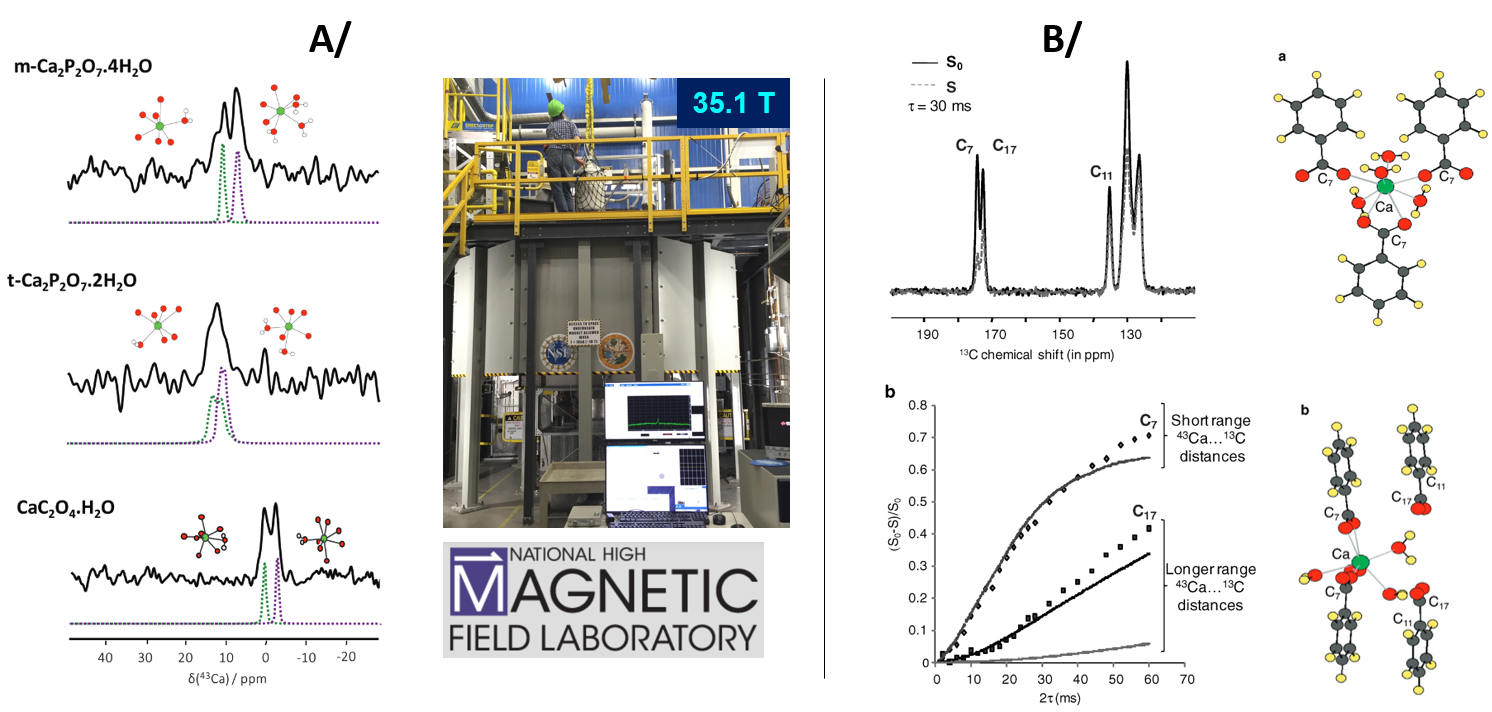
Solid state NMR methodology is developed in the framework of J-derived techniques under fast MAS in connection with the first principles calculations of J couplings by GIPAW (Inorg. Chem. 2007, 46, 1379‑1387; Accounts Chem. Res. 2007, 40, 738-746), exotic non sensitive nuclei such as 43Ca and 87Sr (J. Am. Chem. Soc. 2009, 131, 13430-13440; J. Am. Chem. Soc. 2012, 134, 12611-12628), ultra-broad spectra (Chemistry Select 2016, 4509-4519) and ultra-high magnetic field: 35.1 T, 1.5 GHz (Chem. Commun. 2018, 69, 9591-9594). To the best of our knowledge, the experiments presented in Chem. Commun. 2018, 69, 9591-9594 show the highest resolution in 43Ca solid state NMR ever obtained.
Since 2017, my colleague D. Laurencin (Montpellier, France) and her collaborators develop an extremely ingenious way of 17O labeling using mechanochemistry (Angew. Chem. 2017, 55, 6803-6807). This led to the characterization of broad families of oxides by various 17O solid state NMR techniques (Inorg. Chem. 2020, 59, 13050-13066). Most importantly, and thanks to high 17O labeling, the first direct insight into the local environment and dynamics of water molecules in the whewellite mineral phase, CaC2O4.H2O was achieved (J. Phys. Chem. C 2022, 126, 12044-12059). This mineral phase is of particular importance in the field of pathological calcifications – or kidney stones, see below. Oxalate binding modes in materials were fully characterized (Inorg. Chem. 2024, 63, 10179-10193).
For a mini-review on this topic, see Faraday Discussions 2023, 241, 250-265.
DNP (Dynamic Nuclear Polarization)
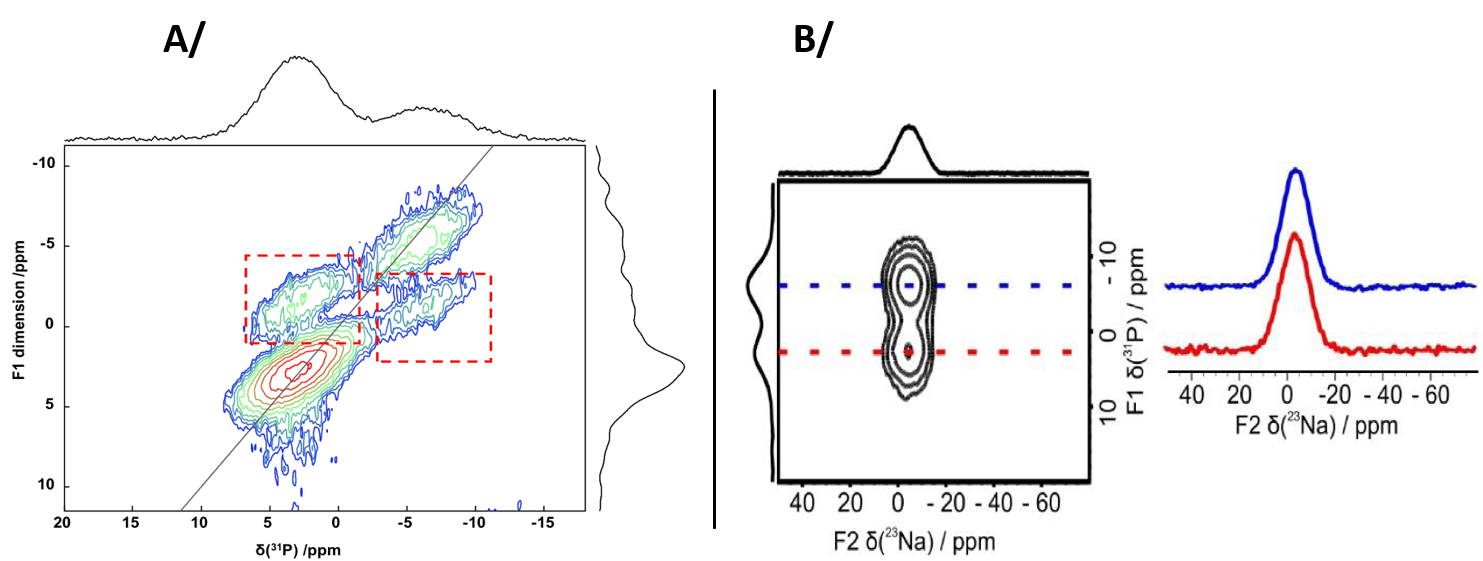
DNP has revolutionalized the description of carbonated hydroxyapatite (Analytical Chem. 2017, 89, 10201-10207). In this case, 1H-1H spin diffusion is quasi one-dimensional along the OH– columns (parallel to the c-axis). Local order and clustering of the carbonate anions were clearly demonstrated by 13C-13C homonuclear correlation MAS DNP experiments. The clusters of carbonates are located in zig-zag chains along the c-axis of the structure. The DNP enhancement is sufficient to implement 1H-43Ca HETCOR experiments in natural abundance which is an extraordinary challenge for this particular nucleus (0.14% and low gamma) (Nature Commun. 2017, 8, 14104).

Instrumentation
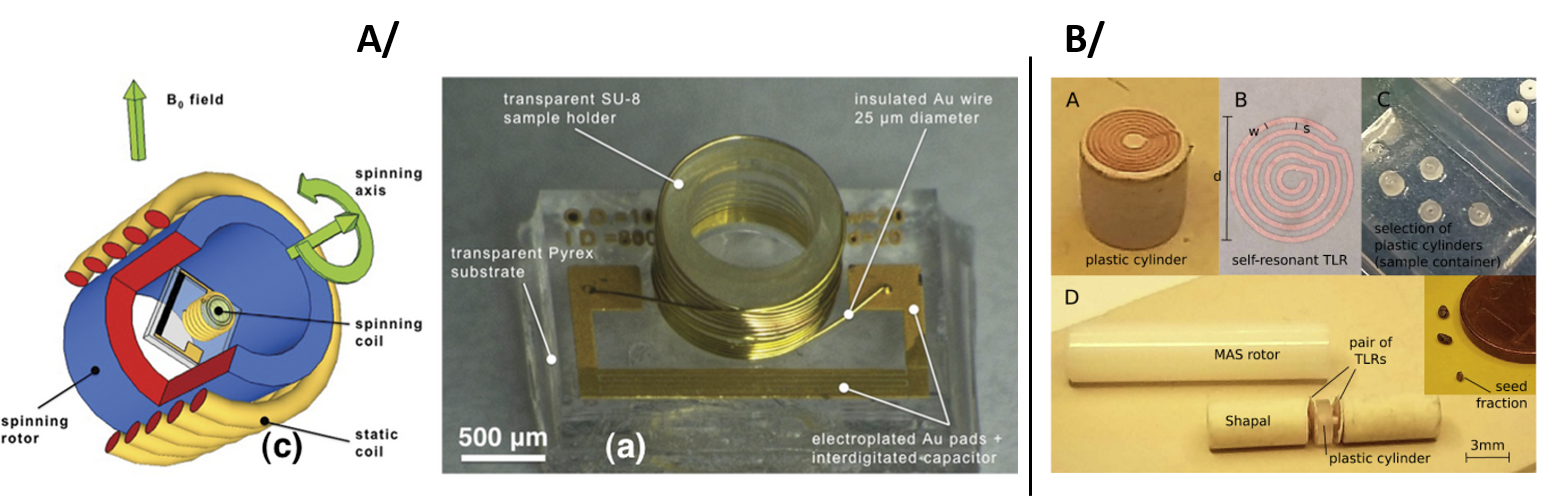
Sensitivity remains the main drawback of NMR. Following Sakellariou et al., MACS (Magic Angle Coil Spinning) is a perfect alternative for samples characterized by a low mass (such as biological samples). The solenoid geometry for the micro-coil is among the most versatile ones, and is suitable for microfabrication (PLOS ONE 2012, 7, e42848) reaching an enhancement of 5-10. Recently, monolithic MACS microresonators were developed for high resolution NMR keeping intact the intrinsic cylindrical symmetry of the set-up and allowing for fast MAS (J. Magn .Reson. 2016, 271, 46-51).
Signal processing
Major improvement has been obtained in the denoising of time-domain signal by using Singular Value Decomposition (SVD) accelarated by Graphics Processing Units (GPU) (Solid State NMR 2014, 61-62, 28-34; J. Magn .Reson. 2016, 271, 46-51). SVD limits have been deeply investigated (Appl. Spectr. Rev. 2019, 54, 602-630). A 100 gain in time was achieved by combining divide and conquer algorithm, Intel Math Kernel Library (MKL), SSE3 (Streaming SIMD Extensions) hardware instructions and single precision. In such case, the CPU can outperform the GPU driven by CUDA technology (Appl. Spectr. Rev. 2020, 55, 173-196).

First principles calculations of NMR parameters, NMR crystallography
Following the pionneering work of Pickard and Mauri (2001), first principles calculations of NMR parameters were systematically implemented in the case of inorganic (Magn. Res .Chem. 2004, 42, 445-452; J. Am. Chem. Soc. 2010, 132, 4653-4668; J. Am. Chem. Soc. 2012, 134, 12611-12628) and organic solids (J. Phys. Chem. A 2005, 109, 6960-6969), biocompatible materials (App. Magn. Res. 2007, 32, 435-457; CrystEngComm 2013, 15, 8840-8847; Acta Biomater. 2016, 31, 348-357), molecular dynamics (Phys. Chem. Chem. Phys. 2009, 11, 6953-6961) and non-crystalline solids (J. Am. Chem. Soc. 2012, 134, 12611-12628; Chem. Commun. 2018, 54, 9591-9594). Carbonate substituted hydroxyapatite derived structures were characterized by extensive modeling and GIPAW calculations of NMR parameters (Chemistry Methods 2023, 3, e202300007). A combination of DFT and GIPAW calculations, Molecular Dynamics (MD), low temperature NMR and DNP experiments has been proposed for ultimate characterization of octacalcium phospate – including local water dynamics (Faraday Discussions 2025, 255, 451-482).
For review articles see: Chem. Reviews 2012, 112, 5733-5779 (631 citations in April 2026) and Chapter 17 – Disorder in Inorganic Materials, in Modern NMR Crystallography: Concepts and Applications RSC, 2025.

Advanced NMR applications in materials science
We focus here on our latest interest in soft-chemistry applied to the systhesis of amorphous calcium ortho/pyrophosphate biomaterials of tunable composition (Acta Biomater. 2020, 103, 333-345) and more generally to advanced NMR methods applied to the characterization of biocompatible materials (Solid State NMR, 2020, 107:101663). A particular focus was put: on alpha-canaphite (CrystEngComm. 2020, 22, 3130-3143); hybrid derivatives of octacalcium phosphates (Mag. Res. Chem. 2021, 940-950); pyrophosphate stabilized amorphous calcium carbonate derived materials for bone substitution (CrystEngComm. 2022, 24, 8011-8026); amorphous calcium pyrophosphate bone cements without any crystallization – in vitro biological studies (J. Mater. Chem. B 2026, DOI: 10.1039 d5tb02873f); th extreme diversity of calcium oxalate structure (Acta Cryst A – Foundations and advances 2023, C390); metabolic acids in shaping bone-like apatitic structures (Chem. Mater. 2026, DOI: 10.1021/acs.chemmater.5c02593). Collaborations with Pr C. Combes (Toulouse), M. Duer (Cambridge).
The latest methodological developments in NMR (ultra-high magnetic field up to 35.2 T, 17O isotopic labeling, high resolution multinuclear experiments, DFT modeling, GIPAW calculations) were applied to extract extremely fine information on MOFs materials, in strong collaboration with Pr Y. Huang – Western Ontario (J. Am. Chem. Soc. 2020, 142, 14877-14889; Magn. Res. Chem. 2021, 940-950; Chem. Mater. 2023, 35, 3555-3569).
Precipitation in confined media
We focus here on the specific precipitation of calcium oxalates in micro-fluidic environments and NMR (DNP) characterization of pathologial calcifications (or kidney stones). Calcium oxalates are the most prominent mineral phases found in human kidney stones. We proposed first a biomimetic prototype involving laminar microfluidics regime to characterize calcium oxalates precipitation (Lab on a Chip 2016, 16, 1157-1160). The impact of the presence/absence of polyphenols in relation with nephrolithiasis was investigated as well (Crystal Growth & Design 2020, 20, 7683-7693). Most importantly, we have used a carbonated apatite-coated microfluidic channel in order to better understand the role of the Randall’s plaque in kidney stone formation (Lab on a Chip 2024, 24, 2017-2024). A complete NMR methodology applied to studies of the hybrid (organic-inorganic) character of kidney stones is fully described in: Magn. Resonance, 2021, 2, 653-671. Collaborations with Pr A. Abou Hassan (Sorbonne University), Dr M. Daudon, Pr E. Letavernier (hôpital Tenon, Paris).
Quantum mechanics and Path-Sum, Ultra-fast numerical methods
In very strong collaboration with P.-L. Giscard (Calais, France), we have applied the Path-Sum concept to NMR for the first time solving analytically the Bloch-Siegert effect at all order (avoiding perturbative treatments), spin diffusion in an organometallic molecule exhibiting 42 protons and giving entirely new insight in Coherent Destruction of Tuneling, CDT (ENC 2019, Asilomar, USA; Phys. Rev. Res. 2020, 2, 023081). Path-Sum relies on graph theory and more specifically on resummation techniques of walks on graphs. We solved the Bloch equations in their most general form by combining for the first time Path-Sum, ★-product and ★-algebra concepts and divided-difference exponentials (collaboration with F. Neto and M. Warnock). The solution relies on a finite number of fully explicit standard operations. We have also demonstrated that bi-tri… frame transformations in physical systems leads to a dramatic increase in accuracy for numerical approaches (arXiv:2510.04598 2025). In a very strong collaboration with S. Pozza (Prague, CR), our goal is to provide ultra-fast codes for differential equations implied in Optimal Control in NMR and MRI (arXiv:2311.0414 2023).

1- 3D MAS MRI of Solid State Pathological Natural Samples (Alpine NMR Conference, 2025, Chamonix, France) – PROMOTED speaker
2- Solid State NMR MAS Imaging & Path-Sum for Spin Dynamics (PANACEA meeting, 2024, Aveiro, France) – INVITED speaker
3- Towards an « Infinite » Number of Calcium Oxalate Structures? (IUCr, 2023, Melbourne, Australia) – KEYNOTE speaker
4- Path-Sum: a New Avenue for Spin Dynamics (43rd FGMR Annual Discussion Meeting, 2022) – PLENARY speaker
5- New Potentialities of NMR & DNP for the Study of Biomaterials: Experiments and Theory (Experimental Nuclear Magnetic Resonance Conference, 2022) – INVITED speaker